

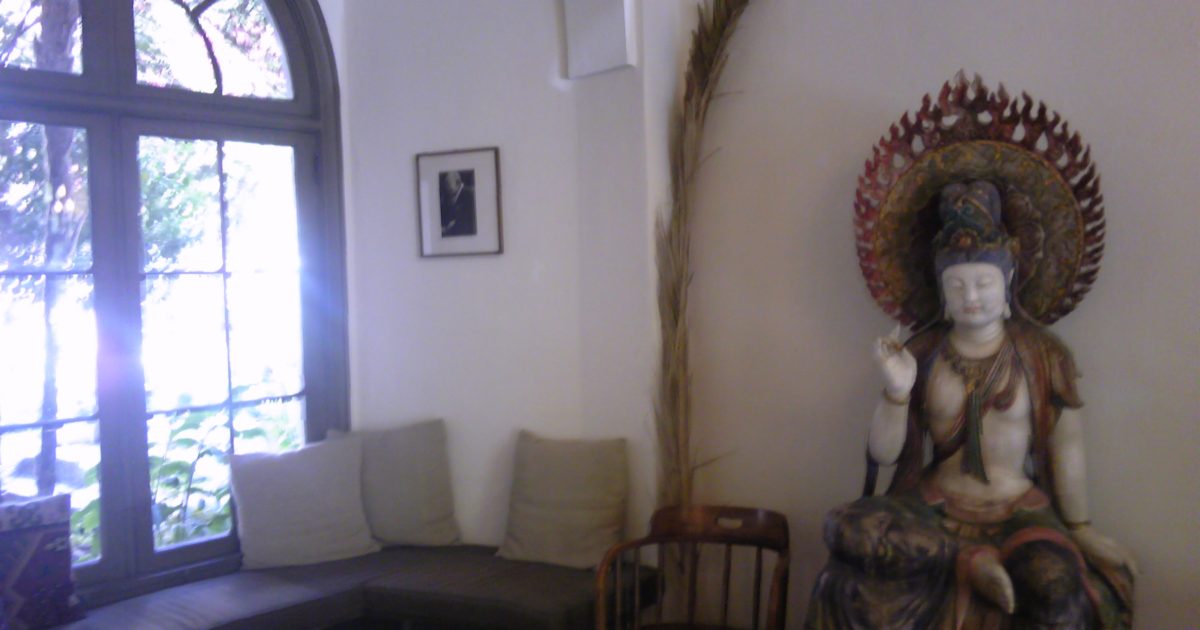
When I take a close look at ikigai workers, I notice the influence from Zen everywhere. There are some reasons.
According to Daisez Suzuki, as Buddhism spread from India to Northeast Asia, metaphysical elements became subsided and transformed into something that reflected the practical mind of the Northeast Asians. They were more interested in directly experiencing the experiment, satori rather than discussing it. Once they experienced it, the non-dual nature of the experience guided them to see no boundaries between sacred and secular, religion and everyday life, and they started to apply the spirit of Zen to everything in their lives. They tried to transform it as a spiritual path toward enlightenment.
It is no coincidence that various types of martial arts, tea ceremonies and flower arrangements were derived from Zen.
They were parts of an enormous project to apply the spirit of Zen to everything. If ordinary things like just serving tea or arranging flowers can be a path or a vehicle of satori, enlightenment, it can cover our entire lives!
The spirit of this project is mostly forgotten today, but there is a bit of that spirit remaining, especially where people aim for excellence. It is no wonder that ikigai workers often look like Zen practitioners. They actually make use of methods originated from Zen to pursue excellence without even noticing it. As Daisez Suzuki says in Zen and Japanese Culture, Zen is so deeply embedded in Japanese culture that it became like water for fish.
Working meditation
My friend Kaori, who learned about the Japanese tea ceremony a long time ago , says that the best thing she learned from it was the discipline of putting all of her energy and effort into whatever she does, no matter how small and unimportant it may be.
Her teacher would often say to her, “Whisk tea as if you feel that the whole universe is swirling there. Serve tea to your guest as if you are presenting your whole self to that person”.
“It sounds hard”, I said. Then, she replied, “On the contrary, it is energizing!”
When you focus on just what you are doing right now, your mind is not divided into more than one part. Then, you are not like people who are only partially there with the rest of their mind wonders elsewhere, thinking things like whether there is any better way to spend time than what they are actually doing”.
In short, it is the opposite of multi-tasking! Doing one thing at a time and being fully absorbed in the one thing we are doing right now…That help us feel more integrated and whole. It is a kind of open eyed meditation.
Putting our entire being into doing something is different from making our best effort. When we move out of our (own) being, it feels like it is being done rather effortlessly, or, to be more precise, like an exuberant sense of life, love or gratitude that is intrinsic in our being just overflows naturally into our actions. Its driving force is an overflow rather than making an effort to fill what we feel is lacking in that situation out of a sense of “not being good enough”. The latter is what our ego does, rather than our being. Some warming up might be necessary for us to realize the difference between the two.
I recently learned a meditation technique called “Inhabiting the Body,” initiated by Non-Dual teacher Judith Blackstone. It consists of entering into each part of our body and inhabiting that place. For example, when we inhabit our hands, we let our whole being enter into the hands, just like stuffing a doll with cotton. In this meditation, we “stuff” our body with our being bit by bit, starting from our feet, one body part after another. When we are done entering into all the parts of our body, we simply enter into the whole body all at once and inhabit it. Then, we feel integrated and whole.
Whenever I “inhabit” the body, which means I let my entire being enter into my body, I felt as if the border between the inside and the outside of the body disappears and there is just one seamless space of awareness. Having practiced this meditation technique for several months, I got the feel of letting my whole being into things besides my body; it could be my action like serving tea or washing the dishes. I realized that every time I let my whole being into something, that something loses its contour and gives way to the seamless space of awareness, which feels like a warm atmosphere that embraces whatever I do.
For example, I am writing this essay on the computer now, trying to let my entire being do this. Then, I feel as if I am embraced in a warm atmosphere filled with a tender energy, and everything I do in this sphere is immersed in a happy, meditative mood. Thoughts about the past and future naturally subside without my making any particular efforts to drive them away, as if they were being pushed out by the emanation of my being that started to inhabit this activity.
According to Zen, we can make every activity in our lives a meditation practice, besides having tea, if we can completely devote ourselves to doing it.
We can try an experiment anytime. It will be an interesting experience.
*
Let me talk about what I experience when I experimented with washing the dishes.
I tried to “inhabit” this simple task, and let my entire being into the action. As I got absorbed in it, the first thing I noticed was that all the judgmental thoughts I had about this task started to disappear; e. g.. it is necessary but undesired, or I am not suited to doing such an unimportant, subordinate task, etc. The part of my ego that ranks things hierarchically or adheres to my preference in work fell off, and I became able to do the task in a more matter-of-fact way. That made me feel more peaceful.
As my judgmental thoughts about the task that came from what I learned in the past started to disappear, so did my thoughts about the future; e. g., I no longer thought about getting it done as quickly as possible, or what I planned to do after that.
A sense of time started to disappear, which made me more process-oriented and I became relaxed.
As I became more process-oriented with washing dishes, things around me started to look beautiful. I was washing just common and cheap tableware which I use every day. They were by no means fine or magnificent. However, the colors appeared to have more shades, and the shapes more delicate nuances, as if I were looking at a masterpiece of painting. I had seen them hundreds of times, but not in such an autotelic manner. It’s more difficult to see things this way while we are working than while you are appreciating artworks in a gallery. However, if we can do that, our whole world looks different.
The next thing I noticed while experimenting with Zen working meditation was that the deeper I was absorbed in washing dishes, the less I became consciously aware of what I was doing. Although I didn’t stop washing dishes and was actually doing it more properly than ever, my awareness of what I was doing started to fade away. That’s probably because we need a certain amount of distance between us and something to see it as an object. I was so completely one with the process of my work that there was no way to objectify it!
Rather than washing dishes, I felt as if I were forming something from which the world is made, which felt great. As the material exists prior to the world’s emerging, it felt like a luminous, pliable clay which could take any form. When I touched it, I felt as if I touched everyone and everything in the world from the inside. The feeling of connectedness made me feel deeply fulfilled.
The best expression I have ever found about this material is the “A Squeeze of the Hand” chapter of “Mobi Dick” written by Herman Melville, where the narrator squeezed whale oil.
…I bathed my hands among those soft, gentle globules of infiltrated tissues, woven almost within the hour; as they richly broke to my fingers, and discharged all their opulence, like fully ripe grapes their wine; as I snuffed up that uncontaminated aroma,-literally and truly, like the smell of spring violets; I declare to you, that for the time I lived as in a musky meadow; I forgot all about our horrible oath; in that inexpressible sperm, I washed my hands and my heart of it; I almost began to credit the old Paracelsan superstition that sperm is of rare virtue in allaying the heat of anger; while bathing in that bath, I felt divinely free from all ill-will, or petulance, or malice, of any sort whatsoever.
Squeeze! squeeze! squeeze! all the morning long; I squeezed that sperm till I myself almost melted into it; I squeezed that sperm till a strange sort of insanity came over me; and I found myself unwittingly squeezing my co-laborers’ hands in it, mistaking their hands for the gentle globules. Such an abounding, affectionate, friendly, loving feeling did this avocation beget; that at last I was continually squeezing their hands, and looking up into their eyes sentimentally; as much as to say, -Oh! my dear fellow beings, why should we longer cherish any social acerbities, or know the slightest ill humor or envy! Come; let us squeeze hands all round; nay, let us all squeeze ourselves into each other; let us squeeze ourselves universally into the very milk and sperm of kindness.
Would that I could keep squeezing that sperm for ever! For now, since by many prolonged, repeated experiences, I have perceived that in all cases man must eventually lower, or at least shift, his conceit of attainable felicity; not placing it anywhere in the intellect or the fancy; but in the wife, the heart, the bed, the table, the saddle, the fireside, the country; now that I have perceived all this, I am ready to squeeze case eternally. In thoughts of the visions of the night, I saw long rows of angels in paradise, each with his hands in a jar of spermaceti.
(Herman Melville; Moby-Dick, University of California Press: London, 1983, 426-427p.)
We can touch this “sperm of kindness” (“sperm” might be a metaphor associated with the word “sperm whale” or its oil, “sprmaceti”, as well as implying a beginning of new life) whenever you are fully absorbed in what you are doing, emptying your mind.
It is so restful for us to feel this luminous material in our hands that it feels like we are doing nothing in the midst of our work.
As long as we don’t lose touch of this material, we are not interested in any form that we create as a result of our work. That’s because this material is a lot more sweeter!Then, every occurrence becomes Ichi-go Ich-e, the first and the last encounter.